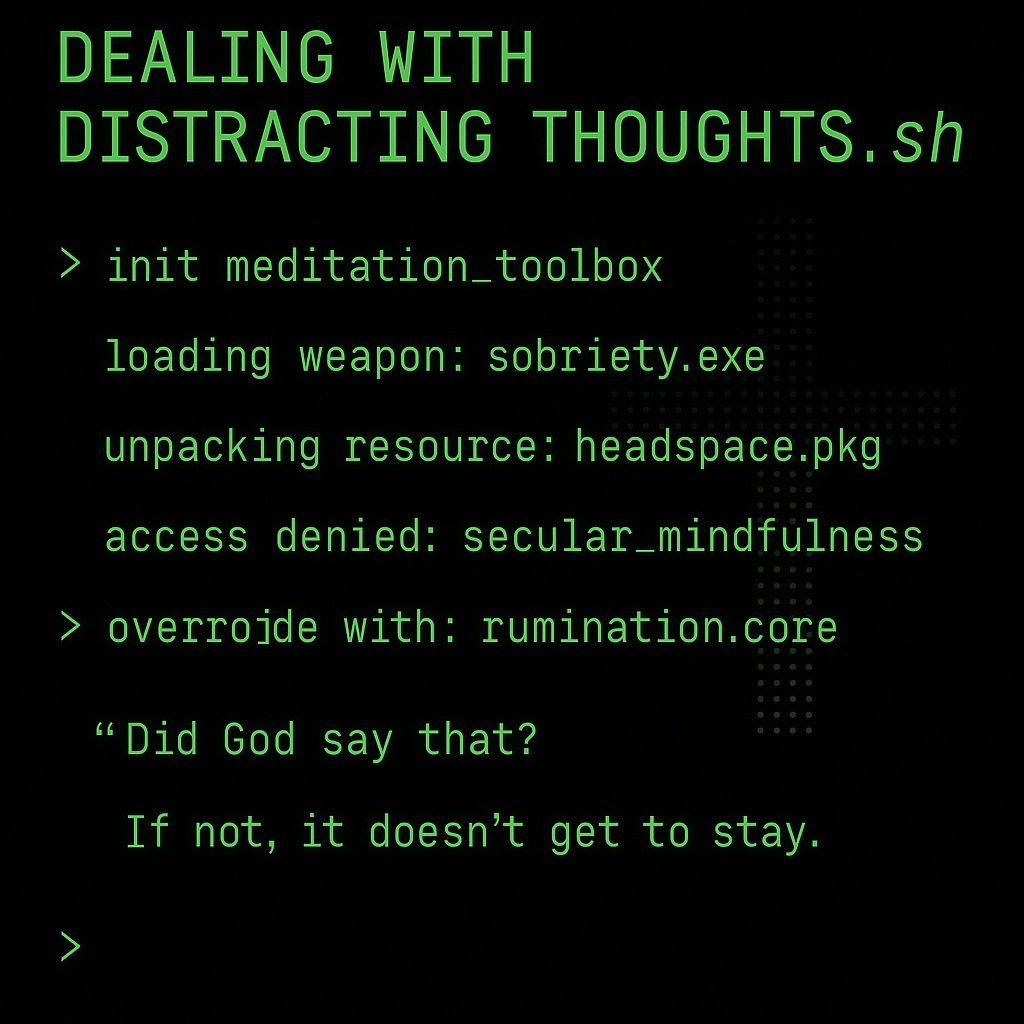
“One of the weapons I picked up wasn’t a gun. It was something I left in the box for years. Meditation. But not the kind they sell you in yoga studios. The kind that leads you to God—not away from Him.”
“Starve the wolf. Keep him from having a say.”
I’ve been working on my first book, The Walking Paths, and hit this section describing the tools I was pulling out of the box about seven years ago—tools I hoped would help me fight the ocean of darkness that had swallowed me whole.
One of those tools—really a weapon—was this:
Stop going to bars.
Stop buying beer, liquor, and wine.
Starve the wolf. Keep him from having a say.
“Just one more” never once worked for me.
Sobriety became a weapon in the war between light and darkness.
Another tool had been handed to me by someone I loved—but I left it in the packaging. Tucked in the top of the toolbox. I’d talk about it with people, say I had it, nod while they nodded, and we’d move on.
But the truth was, I never truly picked it up until years later—when I found an app on another tool I’d had all along.
The tool? Meditation.
The app? Headspace.
“Just one more never cut it even once in my life.”
That app shifted how I saw the things flying around in my head and coursing through this meat sack we call a body.
I read a lot of books about meditation too.
Buddhism had been nipping at my consciousness since high school—Siddhartha, Zen and the Art of Motorcycle Maintenance. I read Surfing the Himalayas in prison. They sharpened my philosophical edges, gave me intellectual toys to play with—but they didn’t fill the hole.
That hole.
The ache.
The vacancy.
God.
Why couldn’t I connect with God?
When I found myself in the undertow of blackness, I reached out—and touched only more blackness. Friends tried to walk with me in the dark. Lovers distracted me. Bartenders numbed me.
But I was still asleep. And something in me knew I needed real weapons.
Not a Mark III.
Not an FN .45 Tactical.
Not an 11.5” AR Pistol.
Not even a Zastava M70.
No.
Not those kinds of weapons.
Because we don’t fight against flesh and blood.
This was spiritual warfare.
“Christian meditation isn’t about detachment. It’s about connection.”
At a free six-week class at the V.A.—sponsored by NAMI, the National Alliance for Mental Illness—I met a teacher. Dreadlocked. Afrocentric garb. Jewelry with stories in it. Her voice moved like ancient rivers and southern winds. She spoke of self-destruction and the darkness trying to devour her. And I knew—I wasn’t alone.
Later that night, I opened the box.
Meditation.
Could I do this?
Search box. Headspace.
Videos. Instructions. Practice.
I tried it.
Weeks of sitting in a chair, eyes closed.
In. Out. Focus. Listen. Observe.
They called it mindfulness.
No—sobriety and mindfulness didn’t banish the darkness.
But there was this little black ball of fur, Eddiebear, a kitten I raised into a gremlin with murder mittens. He showed me light. Love cracked the seal. Graces piled up like pebbles beside the Jordan.
“We take captive every thought. Hold it up to the Light. Interrogate it. ‘Did God say that?’”
Eddiebear and a handful of mercies led me to Jesus.
And here’s the thing about meditation that nobody told me at the bar, at the bookstore, or in the yoga studio:
Secular meditation is not the same as Christian meditation.
Secular meditation teaches you to observe thoughts without judgment. Watch them pass like clouds. Don’t attach. Don’t react. Just breathe. Just release.
But Christian meditation is rooted in something deeper.
Think of the word rumination—it comes from digestion.
To ruminate is to chew slowly. To draw nourishment. To let something become part of you.
Christian meditation isn’t about detachment.
It’s about connection.
“Some thoughts that feel intrusive might actually be divine interruptions.”
We ruminate on the Word.
A verse. A parable. A name of God.
We chew. We swallow.
We let it work its way into the bloodstream, into the bones.
When distracting thoughts rise up, we don’t just let them float away.
We take them captive in Christ.
What does that mean?
It means we grab the thought.
Hold it up to the Light.
Interrogate it.
“Did God say that?”
If not, it doesn’t get to stay.
It doesn’t get a voice in the meeting.
It doesn’t get a seat at the table.
“One leads to silence. The other leads to discernment.”
Secular meditation tells us to evaluate thoughts based on usefulness.
Christian meditation asks us to evaluate them based on truth.
Some thoughts might seem intrusive—but they might also be divine interruptions.
And if you’re not consulting God, you’ll never know which is which.
That’s the difference:
Secular meditation asks:
“Is this thought useful to me?”
Christian meditation asks:
“Is this thought from God?”
One leads to silence.
The other leads to discernment.
> run discernment –filter=truth
> intrusive_thoughts.scan()
> divine_interruptions.detected()
> engage spiritual_warfare

 The Walking Paths